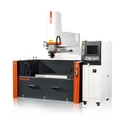
1. The operator must be familiar with the structure and performance of the machine tool, and can only work after passing the training. Non personnel are strictly prohibited from using wire cutting equipment without authorization. It is strictly prohibited to use wire cutting equipment with high performance.
2. Preparation and confirmation work before operation
1) Clean up the waste and impurities in the workbench and workbox, and do a good job in the 5S work of the machine tool and its surroundings.
2) Check and confirm if the working fluid is sufficient, and add it promptly if it is insufficient.
3) When unmanned or precision machining, it is necessary to check and confirm whether the electrode wire allowance is sufficient and sufficient. If it is insufficient, it should be replaced.
4) Check and confirm the amount of waste silk in the waste silk bucket. If it exceeds 1/2, it must be cleaned up in a timely manner.
5) Check if the inlet pressure of the filter is normal and if the compressed air supply pressure is normal.
6) Check for any dirt, looseness, or breakage in the inter pole wires, and confirm if there is any interference in the inter pole wires when moving the workbench.
7) Check the wear of the conductive block. When worn, the position of the conductive block should be changed. If there is dirt, it should be cleaned thoroughly.
8) Check whether the pulley runs smoothly and whether the electrode wire runs smoothly. If there is any jumping, check and adjust it.
9) Check if the electrode wire is vertical. Before processing, the verticality of the electrode wire should be straightened.
10) Check if the lower guide device is loose and if the upper guide device opens and closes smoothly in place.
11) Check for any defects in the nozzle; Is the lower nozzle 0.05-0.1mm lower than the workbench.
12) Check and confirm whether the relevant switches and buttons are sensitive and effective.
13) Check and confirm if the machine tool is operating properly.
14) When abnormal phenomena are found in the machine tool, it is necessary to report them in a timely manner and wait for processing.
3. Precautions for workpiece clamping
1) Before clamping the workpiece, it is necessary to clean the rust residue and impurities thoroughly.
2) The installation surface of cutting workpieces such as templates and templates should be polished and trimmed with an oilstone before clamping to prevent unevenness, affecting clamping accuracy, or interfering with the lower nozzle.
3) The clamping method of the workpiece must be correct to ensure that the workpiece is straight and tight.
4) It is strictly prohibited to use sliding screws. The locking depth of the screw should be at least 8mm, and the locking force should be moderate, not too tight or too loose.
5) The pressure block should be clamped flat to ensure even and balanced force on the clamping parts.
6) Be careful during the clamping process to prevent the workpiece (sheet) from becoming unstable and falling off.
7) The position of the workpiece clamping should be conducive to the alignment of the workpiece and suitable for the machine tool stroke, which is conducive to programming cutting.
8) After clamping the workpiece (plate), it is necessary to check again to confirm whether there is any interference with the machine head, inter pole line, etc.